sept 16
in today's class we discussed the readings
We talked about Barbara Fischer's top ten:
Linda Nochlin, Museums and Radicals: A history of Emergencies
Brian O'Doherty, Inside the White Cube: Notes on the Gallery Space
Michael Fried, Art and Objecthood
Donald Judd's Project in Marfa
Hans Haacke's sequence of works:
Lucy Lippard's book, Six Years: the Dematerialization of the At Object from 1966 to 1972
A-historical Exhibitions
Artist Projects
General Idea
Miwon Kwon's ne Piece After Another: Site Specific Art and Location Identity
I defiantly don't have my own top ten but I can think of my top 5 that I have seen/read (not int specific order),
General Idea, I saw General Idea in at the National Gallery about three years ago on a field trip with my class and I didn’t know much about it at the time but I really admired the visual aspects of the show. Then later after doing research I find it a lot more interesting.
Janet Cardiff, Forty-Part Motet, I love this piece, I saw it during a really hard time in my life and I think that’s why it has stuck with my so much. I sat on the bench and heard the cycle about 3 times, I thought it was so innovative and I loved the actual sound of the singing.
Kent Monkman: A History is Painted by Victors
Feminism, Pedagogy, and the Studio: Reflections Across Four Decades by Griselda Pollock, this is a book I bought in Montreal and I read it when I had down time. I found it really insightful.
Enfolding, curated by my group and I, This is more of a joke but I am very proud of myself and my group members for working hard to curate this exhibition and I learned a lot about what it takes to curate an actual exhibition.
Writing Promt 1:
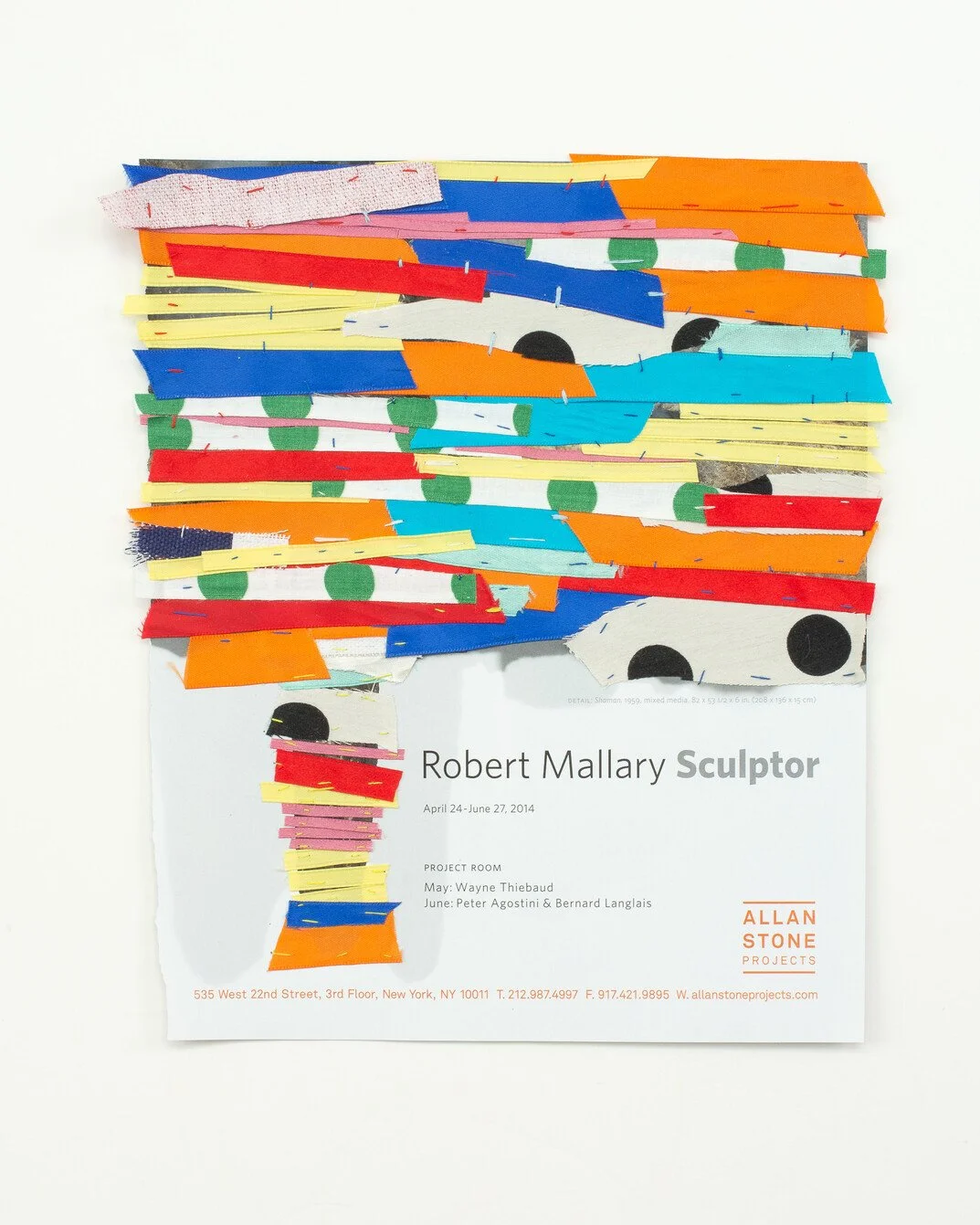
textile tag #169 is a piece by Julia Couzens, a Sacramento based, multimedia artist. It is a magazine ad for a Robert Mallary exhibit from 2014 that she has altered with fabric. Couzens has stitched on strips of multi coloured fabric over the entire top half of the magazine, as well as a small section on the bottom. She deliberately covers the photo of his work and anything that indicates to the viewer what the exhibit might entail. Whether she deliberately left little gaps between the strips of fabric, or it was done very spontaneously, it helps guide the viewer to the conclusion that she is trying to cover and disrupt the content on the magazine. The only thing left is his name, the dates of the exhibition, the address, and the next exhibitions coming up. The collection of altered magazines started as an act of protest against the patriarchal and hierarchal systems within the art world. In 2014, Artforum showed 73 ads associated with New York galleries, of the 73 artists that were advertised, only 11 showed women artists. Her choice to deface the magazines using textiles shows a display of protest through a practice traditionally done by women and historically ignored as a legitimate art practice. The use of this “forgotten practice” parallels how the women artists were overlooked and ignored.
Make it stand out
Julia Couzens "textile Tag #169" 2021, Magazine ad, mixed textiles, thread, 11 x 9in
